


Rules of the Day
2-16-2026
Click here for a copy of the lectures notes I wrote in class
Click here for a copy of the Phthalate ester MOTD from today
Click here for a copy of the handouts I used in class today
Featured Golden Rule of Chemistry: 2. Five- and six-membered rings are the most stable.
1. Diazomethane converts carboxylic acids into methyl esters in very high yield.
2. The important carboxylic acid derivatives are acid chlorides, anhydrides, esters, and amides.
3. You are responsible for learning the nomenclature of carboxyic acids (Section 17.2) and the carboxylic acid derivatives of esters and amides only (Section 18.1C and 18.1D).
4. Amides are amazing functional groups. The lone pair on nitrogen is shared in a delocalized pi system involving three atoms, the N, C, and O of the amide (third contributing structure). The amide nitrogen atom is therefore sp2 hybridized, not sp3 as you might expect. This also means there is partial double bond character (restriction of bond rotation) of the C-N bond and the carbonyl O atom has a lot of electron density, making it better at hydrogen bonding. These properties are responsible for life as we know it because they provide the structural elements necessary to form stable 3-dimensional objects from long 1-dimensional chains of amino acids.. See the picture of the day for more details.
Click here to listen to a Jingle that says "Amides are the Best"
5. Carboxylic acid derivatives all have leaving groups of various abilities. The more stable the anion, the better the leaving group, so relative leaving group abiilty is correlated with relative pKa of leaving group conjugate acid (lower pKa is better as lower pKa of a conjugate acid correlates with better anion stability). The better the leaving group, the more reactive the carboxylic acid derivative.
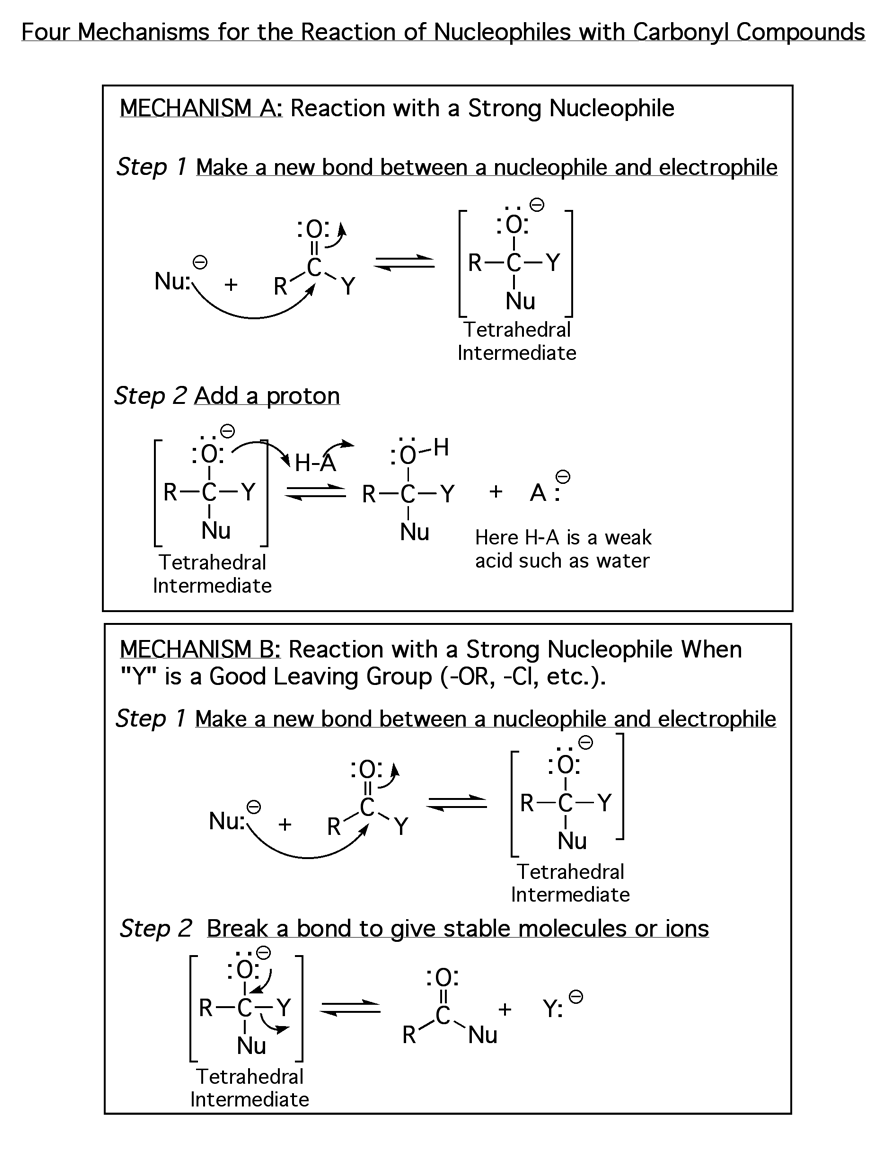
6. Carboxylic acid derivatives react though variations of Mechanism B because they all have leaving groups of various abilities attached.
7. Acid chlorides and anhydrides are very reactive, esters are moderately reactive, and amides are unreactive.
8. You can make any of the less reactive carboxylic acid derivatives from any of the more reactive ones with the appropriate nucleophiles. You can make acid chlorides from carboxylic acids. You can make carboxylic acids from the hydrolysis of any of the carboxylic acid derivatives. Therefore, you can convert any carboxylic acid derivative into any of the other ones.
9. All of the carboxylic acid derivative mechanisms involve the four mechanistic elements: Make a bond, Break a bond, Add a proton, Take a proton away.
Homework:
Read: Sections 18.3-18.4 in the ebook textbook. This text is part of the Longhorn Textbook access program.
Take the Daily Quiz 8 before 10 PM tomorrow. Click here to access the quiz. These quizzes are designed to review the important material from today's lecture.
There is no Aktiv or Gradescope Homework while the TA's are grading the 1st Midterm.